

(Passive Charging, high altitudes)
Not a refereed publication - but a pretty good review, anyway, from an invited talk at a 1989 conference in Huntsville: Current Limiting Mechanisms In Electron And Ion Beams Experiments. Some material which was never published elsewhere is given here. Conference was the "First Workshop on Current Collection from Space Plasmas, held at UAH, April 24-25, 1989.
As I was finishing up at San Diego, Elden and I had this conference publication, which includes the ATS-5 ion gun tests. Experiments on Regulation of Electric Charge on Space Vehicles
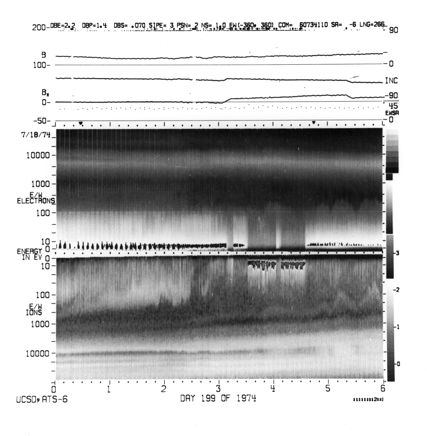
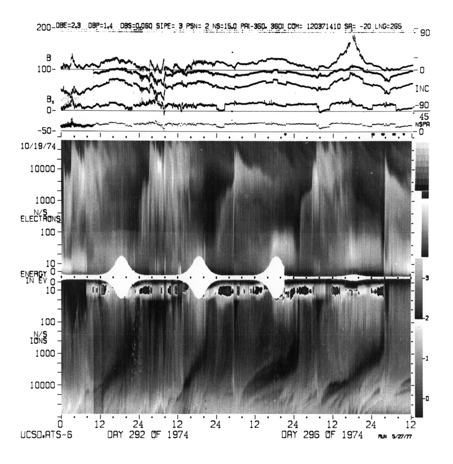
The above two figures show the ATS-6 Ion Engine experiments. The one on the left is the short operation in June, 1974. This image shows the data from the EW detector - data from the NS detector are given in the article. The one one the right is the 4.5 day operation in October.
There were a handful of formal and informal pubs on active charge control. Two were published in 1981 in the Journal of Spacecraft and Rockets. Subsequently, I was asked to do a review article, which ended up mostly being a combination of the first 2 papers, but I used the opportunity to add an unpublished ATS-5 ion beam experiment, and the results of one of the SCATHA electron-gun tests in eclipse.
Modification of Spacecraft Potentials by Thermal Electron Emission on ATS-5
Modification of Spacecraft Potentials by Plasma Emission on ATS-6
Experiments In Charge Control At Geosynchronous Orbit
There is a contract report by myself and Elden Whipple from 1979 that includes all the grungy details on how the cesium ion engine experiments were done, and a lot of the results. There is also a fair amount of info on Differential Charging Observations.
We did a lot of work with the SCATHA electron guns. One of the really perverse things that was observed, during a sequence of observations with the 50-eV beam setting, was return electron fluxes at 70 eV. We had real-time printout from the UCSD instruments, so we knew this was occurring. Herb Cohen and I spent a lot of time during the operations discussing whose calibration was off.
The work was published in an odd venue - the Journal of Electrostatics. I forget why - some sort of special issue, or some such. Electron Beam Experiments at High Altitudes (I don't have the original spectrograms, so I used some alternate color spectrograms I had to rebuild the article).
The work on ATS-6 ultimately led to the proposal for an ion source on the NASA International Solar Terrestrial Program (ISTP). A Hughes plasma source ultimately did make it into orbit on the Polar satellite, some 15 years after the initial proposal was submitted. Spacecraft Potential Control By PSI On The Polar Satellite, Comfort et al. It worked pretty well, but it really messed up the plasma wave data. (RCA had a fire in the clean room - not a good thing for a satellite.)
The Liquid Metal Ion Gun (LMIG) on Cluster worked as well, and was much kinder to the plasma wave data. Active spacecraft potential control for Cluster – implementation and first results by Torkar et al (2001).. Curious history to this. As I was getting ready to leave Huntsville for Monterey, Rudi Schmidt asked me to go to ESA (in Noordwijk) to talk about charge control for Cluster. He and I worked out the experiment team. We needed a European national to head the project. Rudi was about to become the Cluster program scientist, so he could not lead it. We got Professor Willi Riedler to take the project, in Graz, Austria. Professor Riedler was a pretty important guy - he had a lot of things to handle, so Klaus Torkar (Graz), and the technicians in Noordwijk ought to get most of the credit. Here is a a fairly recent talk (Torkar et al, 2003)
(See the special issue of Annales Geophysicae, Volume 19, Number 10 - 12, 2001. Other articles that showed the impact of the charge control device: Szita, S, et al, Cluster PEACE observations of electrons of spacecraft origin Ann. Geophys., 19, 1721-1730, 2001) Just wish somebody would go back and pay attention to phase-space-invariance when they do this stuff.
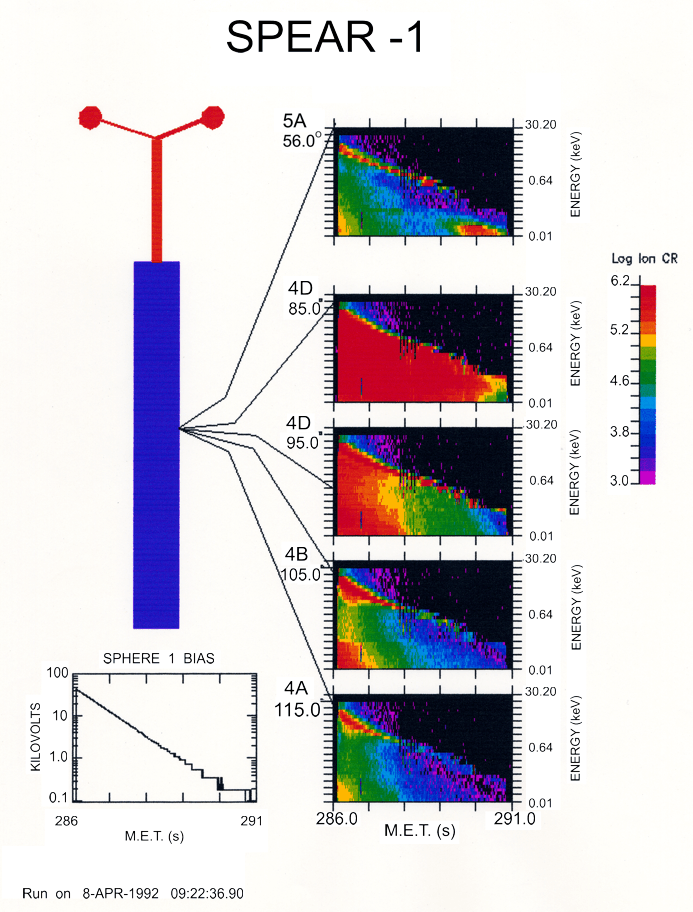 (you may have trouble viewing the pdf if you just click on the figure - try saving then viewing) | I did a bunch of work on the SPEAR projects (Space Power Experiment Aboard Rocket), very little of which was published. These were a pair of sounding rocket experiments conducted by John Raitt at Utah State University. The idea was to look at the effects encountered with high-voltage systems in space. One of my better, early students, Army Captain Thurston Van Horn, worked on SPEAR-1, analyzing the particle data taken by Roy Torbert's electrostatic analyzers. (Roy and I were buddies, of sorts, from our common time in Huntsville. We even swapped houses one summer while he was exploring his move to Huntsville; my family got a vacation in San Diego. He eventually went to New Hampshire, where he has prospered). Here is a short article given at an ESTEC symposium in 1990. SPEAR-1 Charging Behavior, by R. C. Olsen, T. Van Horn, R. B. Torbert, and W. J. Raitt I was also involved with SPEAR-3, which shows up in the thesis by James Morris. |
I was really interested in the question about electromagnetic waves during active experiments. This was at least in part from a contamination concern, but it seemed like a really good venue for studying basic plasma physics. I'm pretty sure most of what we ended up studying was artifacts in the electron and ion sources. Just before ISEE-1 re-entered, we got permission to exercise the electron guns for the first time in a decade. (Something about the first time they were operated, Lou Frank, and some badly saturated detectors. It may be that Forest Mozer laughed about it.....) I got a guest-investigator proposal to do this, in fact. We only analyzed a portion of the data - Roger Anderson was pre-occupied with building the Geotail instrument, as I recall.
Plasma_Wave_Observations_During_Electron_Gun_Experiments_on_ISEE
Electron gun and ion gun operations on SCATHA were also studied.
The DE-1 charging stuff is under Ion Composition (Hidden Ions)
Passive Charging (geosynchronous)