

Spacecraft potential control by the plasma source instrument on the POLAR satellite
Comfort, R. H., Moore, T. E., Craven, P. D.
Journal of Spacecraft and Rockets, Nov/Dec 1998, Vol. 35, Issue 6;
pp. 845-859

AIM-97-2416
SPACECRAFT POTENTIAL CONTROL BY PSI ON THE POLAR SATELLITE
R. H. Comfort, The University of Alabama in Huntsville, CSPAR, EB 136L, Huntsville, AL 35899
T. E. Moore, P. D. Craven, Space Sciences Lab/Code ES 83, NASA/Marshall Space Flight Center, Huntsville, AL 35812
C. J. Pollock, Southwest Research Institute, Bldg 178, P. O. Drawer 28510, 6220 Culebra Road, San Antonio, TX 78284
F. S. Mozer, University of California, Berkeley, Space Sciences Laboratory, Berkeley, CA 94720
W. T. Williamson, Hughes Aircraft Co. Research Laboratories, 3011 Malibu Canyon Road, Malibu, CA 90265
ABSTRACT
The Plasma Source Instrument (PSI) on the POLAR satellite is demonstrated to effectively clamp the spacecraft potential to +1.8 V, permitting the measurement of low energy ions which would otherwise be unobservable. Effects of PSI operations on observations of low frequency electric fields by the Electric Field Instrument (EFI) and observations of 1-10kHz waves by the Plasma Wave Investigation are also shown. Since the EFI observations indicate a disturbance of the sheath electric field surrounding the spacecraft, a crude model is proposed to explain the nature of the disturbance, and to thereby provide a means for addressing possible consequences for low energy particle observations.
INRODUCTION
It is increasingly recognized that the low energy core plasma is a critically important part of magnetospheric plasma transport, yet this plasma cannot be accurately measured from spacecraft at potentials much different from that of the ambient plasma. In low density regions like the polar cap and lobes, spacecraft charge positively, excluding core ions from the spacecraft and accelerating core electrons so much that their velocities cannot be measured with any accuracy. In regions of high electron pressure and temperature, spacecraft charge negatively, excluding the ambient core electrons and accelerating the core ions so much that their velocity cannot be measured with any accuracy. The Plasma Source Instrument, or PSI, is a vitally important part of the Thermal lon Dynamics Experiment, or TIDE, that corrects both positive and negative charging problems through the emission of electrons and Xenon ions as needed to regulate the potential near that of the ambient plasma.
OPERATIONAL CHARACTERISTICS
The TIDE-PSI complement is on board the POLAR satellite, which is part of the United States ISTP group of spacecraft making observations in the vicinity of the Earth1,2. POLAR was launched in February, 1996 into a polar orbit with apogee near 9 RE and perigee near 2 RE geocentric. Prior to the activation of most of the POLAR instruments, PSI underwent an activation period during which the TIDE-PSI team gained experience in starting and obtaining effective operations. Since then, PSI has been operated a number of times in a mode that effectively regulates the POLAR floating potential at approximately 1.8 V positive, with TIDE operating. An example of the effect of PSI on the POLAR floating potential, as recorded by the EFI probes, is shown in Figure 1. Also illustrated is the capability to exert fine control over the POLAR floating potential using a bias supply integral to the PSI electronics. The relationship between PSI bias and the POLAR floating potential is shown in Figure 2.
Figure 1. Effect of PSI on POLAR spacecraft potential
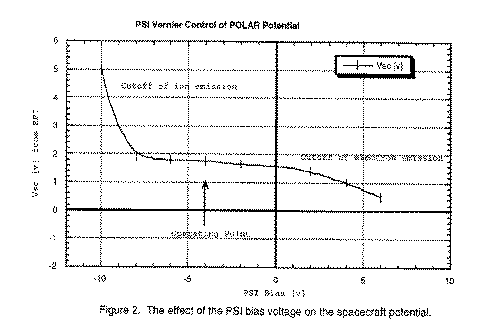
Figure 2. The effect of the PSI bias voltage on the spacecraft potential.
The PSI routine operating point has been chosen to minimize its emission of white noise, which raises the plasma wave background of the Plasma Wave Instrument (PWI). This is a particular problem in the 1-10 kHz range, as illustrated in Figure 3. Some evidence exists that PSI operations excite natural emissions at characteristic modal frequencies, as might be expected from the introduction of white noise into the system. At this time, it is not certain whether PSI actually emits white noise, or alters the coupling of the probes to the spacecraft and other electronic systems, or some combination of the two.
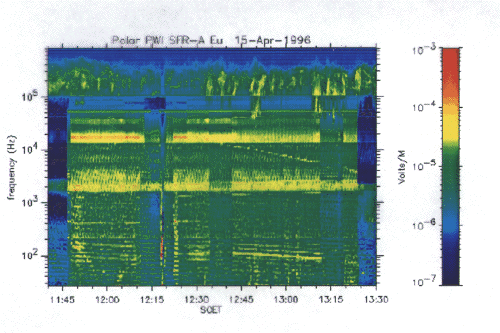
Figure 3. PWI frequency spectrogram for 15 April. PSI is on from about 11:47 to 13:24.
PSI also affects the Electric Field instrument (EFI) probe measurements of low frequency electric fields. In particular, the spin-plane components of the electric field are altered by spurious potentials of approximately 500 mV over the 100 m tip-to-tip separation, as shown in Figure 4. Though somewhat contrary to the expectation of a reduced sheath thickness with PSI operating, the existence of residual electric fields of small amplitude is a natural consequence of localized charge separation in the plasma plume near the spacecraft, as discussed below.
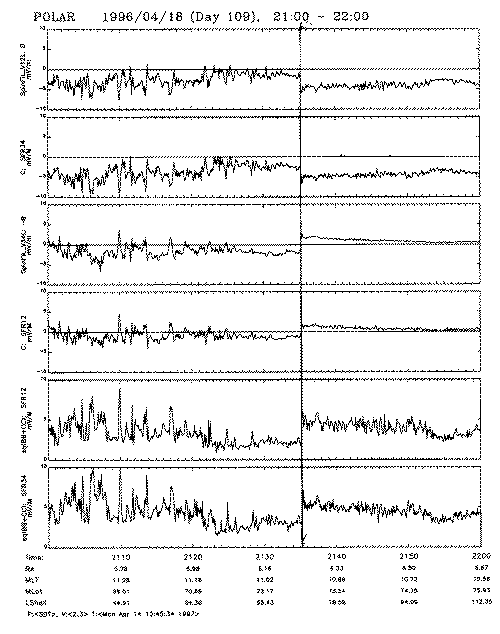
Figure 4. Electric field measurements from EFI.
SCIENCE RESULTS TO DATE
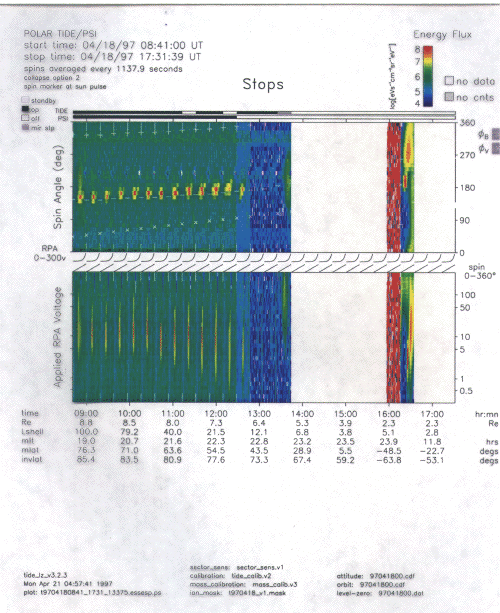
The POLAR spacecraft normally floats as much as 40-50 V positive during passes over the polar cap, as shown by example in Figure 5. PSI operations drastically change this situation, stabilizing the potential at a known value which has been set at +1.8 V. With PSI running, TIDE is able to observe high Mach number field-aligned flows that extend throughout the polar cap, as shown in Figure 6. It turns out that these flows have energies in the range of 10's of eV in the case of H+, somewhat higher for heavier species, and with a downward trend from dayside to nightside. Figure 7 shows an example of the measured velocity distribution, in which the flow has a Mach number on the order of 5. These beams are so cold that they are not well resolved in the mode used to date, so this is a lower limit on the Mach number in this case. Other cases with higher temperature, but comparable parallel velocities, have also been observed. Geophysical variations of the perpendicular ion drifts have also been observed, indicating that measurements of the perpendicular electric field may be recovered.
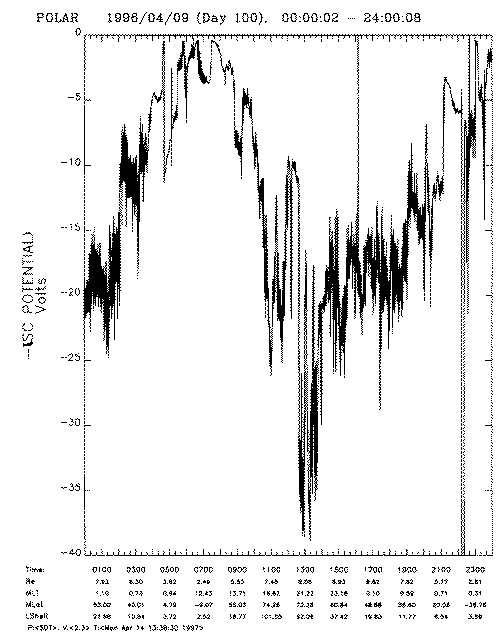
Figure 5. Spacecraft potential over the polar cap without PSI operating, as measured by EFI.
The disturbance of the electric field sensed by EFI indicates that operation of the plasma source disturbs the sheath electric field around the spacecraft, introducing a field that will deflect low energy particles to some degree as they approach it. The plasma flow observations above indicate a high Mach number, magnetic-field-aligned flow that bears little evidence of any strong deflections by the disturbed spacecraft sheath and is loosely consistent with a purely radial sheath field. Nevertheless, we know from the EFI measurements that the electric field around the spacecraft is disturbed by PSI plasma emission, and it is essential to assess the magnitude of this effect on the particles being observed.
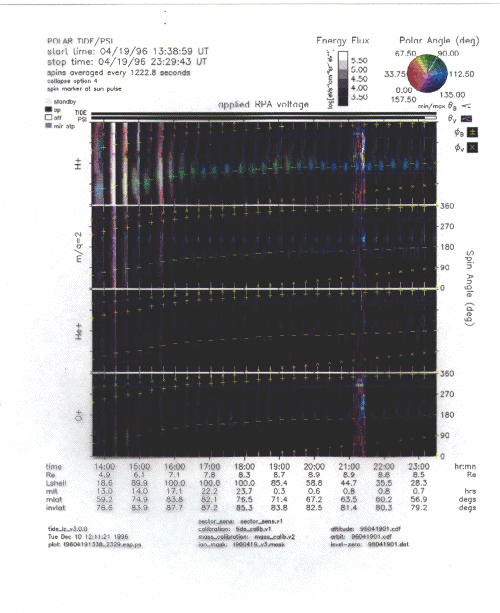
Figure 6. Chromogram plot of polar wind with PSI running.
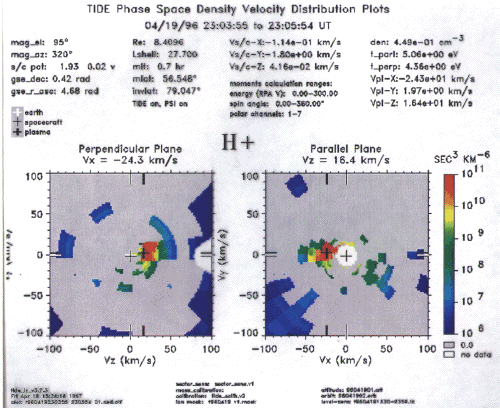
Figure 7. TIDE velocity distribution of polar wind.
SHEATH MODEL
The TIDE-PSI team is in the process of developing a quantitative model of the PSI sheath that will provide the 3D potential associated with the PSI plasma plume. In the absence of quantitative results, it is useful to consider the characteristics of the model, using the EFI measurements to provide a quantitative normalization sufficient to assess the magnitude of particle deflections.
The basic model of the disturbed sheath is illustrated in Figure 8, which shows two schematic views of the POLAR spacecraft at different scales. The left panel is a view along the local magnetic field with the spin axis directed toward the left, while the right panel is a somewhat zoomed-out side view of the spacecraft with the local magnetic field oriented from left to right. The essential features of the potential distribution near the space craft can be understood as a cleavage of the electrons from the ions of the PSI plasma emission. The source electrons have gyroradii with a distribution that peaks in the vicinity of 30 m, while the Xenon ions have a distribution that peaks around 20 km. Thus, in the vicinity of the spacecraft, there is a region of positive space charge spread very broadly above the plasma emission direction in this view, while there is a region of negative space charge that is centered below the plasma emission direction, and in the vicinity of the EFI probe that is most nearly perpendicular to the local magnetic field at any given time.
After separating, the electrons and ions depart from the spacecraft vicinity along the magnetic field, merging back together so as to form a nearly neutralized column over a distance scale that is unknown, then conforming to whatever plasma flow and drift is present in the flux tube. This is illustrated in the right panel of Figure 8. Clearly, a region exists in which ions are deflected in the sense illustrated.
Based upon the EFI electric field observations, we can estimate the magnitude of the potentials near the spacecraft. Since the EFI booms are roughly an electron gyrodiameter away from the spacecraft, the probe on the electron side to the spacecraft is bathed in the largest space charge concentration anywhere in the disturbed sheath. Since the Xenon gyroradius is so much larger, the positive space charge is relatively diffuse, and there is little space charge in the vicinity of the probe on the ion side of the spacecraft. Thus the 500 mV from tip to tip is largely concentrated on the electron side of the spacecraft, and we can infer that the negative space charge concentration on that side of the spacecraft leads to a local potential on the order of 500 mV relative to the spacecraft.
This being the case, a criterion for vanishing deflection of the particles is that they have energies of greater than about 10 times the value of 500 meV. Thus, 5 eV and higher energy particles are relatively unaffected by the disturbed sheath, except that they do, of course, lose (gain) 1.8 eV energy upon approach to the spacecraft, in the case of the ions (electrons). Clearly, we have no reason to expect that the high Mach number ion flows observed by TIDE should be significantly defected by the PSI sheath disturbance. On the other hand, the ambient electrons accompanying these ion flows have much smaller flow energy, larger thermal velocity, and lower Mach number. Clearly, the core electrons below 5 eV (6.8 eV measured energy) should exhibit detectable effects of defection in these disturbed sheath fields. Subtle departures from electron gyrotropy may be observed at somewhat higher energies, as well.
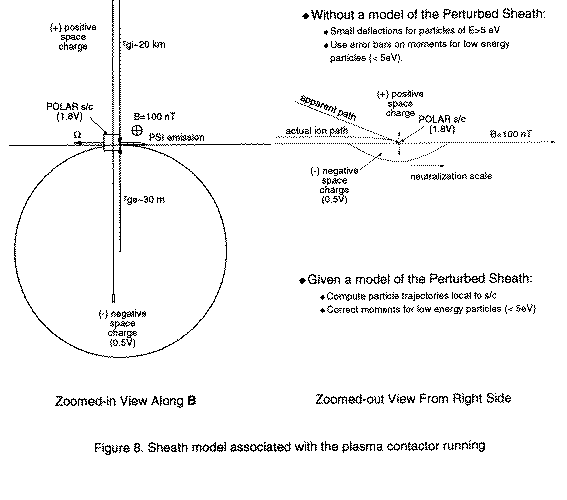
Figure 8. Sheath model associated with the plasma contactor running
CONCLUSIONS
It has been asserted that TIDE-PSI needs a better understanding of the PSI sheath to make quantitative measurements. The core ion measurements are shown here to be quantitatively useful. The core electrons are more affected by the PSI sheath, and at lower outflow speeds, the ions will also be affected, requiring a better understanding of the sheath. The best understanding of the PSI sheath will come from synoptic operations of PSI and dedicated analysis of the complete POLAR plasma data set.
ACKNOWLEDGEMENTS
Work done by R. H. Comfort was supported by NASA NCC8-65.
REFERENCES
1. Moore, T. E., C. R. Chappell, M. O. Chandler, S. A.Fields, C. J. Pollock, D. L. Reasoner, D. T. Young, J. L. Burch, N. Eaker, J. H. Waite, Jr., D. J. McComas, J. E. Nordholdt, M. F. Thomsen, J. J. Berthelier, and R. Robson, Space Sci. Rev., 71, 409, 1995. 2. Harvey, P., F. S. Mozer, D. Pankow, J. Wygant, N. C. Maynard, H. Singer, W. Sullivan, P. B. Andesron, R. Pfaff, T. Aggson, A. Pedersen, C. -G. Falthammar, and P. Tanskannen, Space Sci. Rev., /1, 583, 1995. 1. 3. D. A. Gurnett, A. M. Persoon, R. F. Randall, D. L. Odem, S. L. Remington, T. F. Averkamp, M. M Debower, G. B. Hospodarsky, R. L. Huff, D. L. Kirchner, M. A. Mitchell, B. T. Pham, J. R. Phillips, W. J. Schintler, P. Sheyko, and D. R. Tomash, Space Sci. Rev., 71, 597, 1995.