

Field aligned ion streams - ATS6 analysis of ions that inferred field-aligned flows. This analysis was done on an Evans & Sutherlands Picture System - McIlwain's rightful pride & joy. This was a vector graphics machine that is still hard to match, 25 years later. (http://portal.acm.org/citation.cfm?id=642089.642092, pdf file) It allowed you to fit the data by turning the knob, and the raster space was 4096×4096. What a concept. In a fortuitous accident, I had sprained an ankle rather badly. It hurt too much to hobble over to the printer every few minutes, so I had to learn to program the interactive way. Curiously, my paper was one of the first publications to suggest there was a significant oxygen content to the magnetospheric ion population, but nobody seems to have paid much attention. I even got O++, though looking back now, I'd have to doubt the results showing more O++ than O+. Mass spectrometer measurements on DE-1 would generally discount that result. (I got similar sorts of results looking at bulk motion during pulsations (Pc 5), in some unpublished work.)
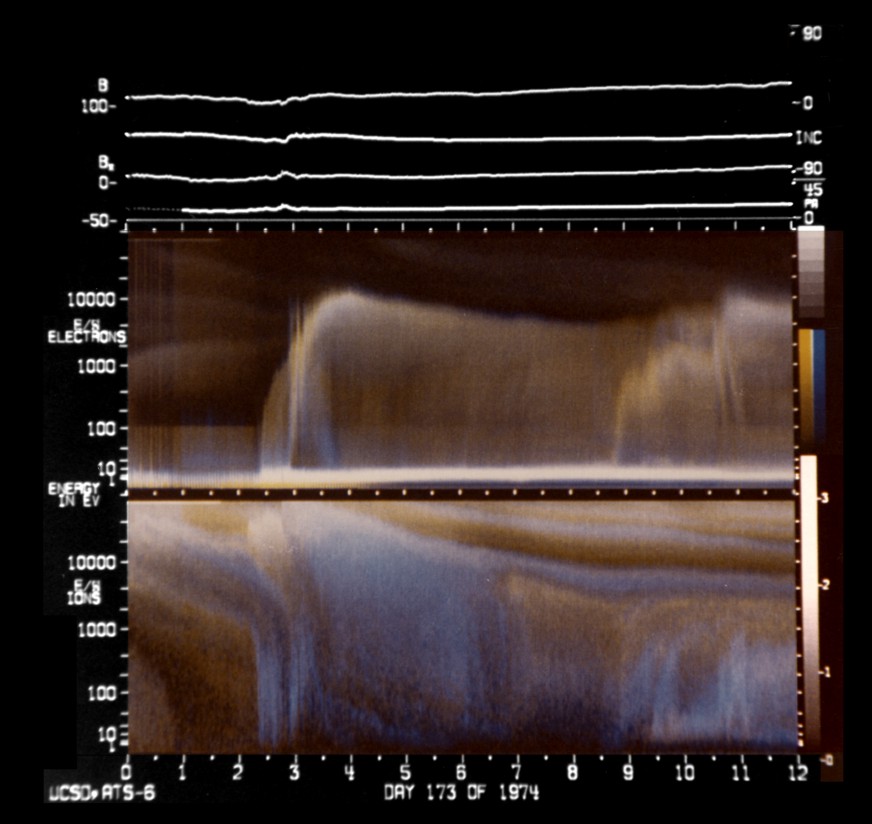 | Just in passing - you can seen the character of the field-aligned plasmas in the ATS-6 data, as shown here. This is an old McIlwain figure. He used the EW detector to measure the perpendicular fluxes, the NS detector parked parallel to the field line, and got the dual measurements shown here. He made this image with an old Contax 35mm camera in his office, by photographing the two B&W spectrograms through a yellow and blue filter, respectively. Blue means field aligned. You can see the effects of pitch-angle on grad-B convection in the deep-proton minimum. McIlwain is red-green color-blind, so the emphasis at UCSD was always on good black and white graphics. The local thought in San Diego was that color should be reserved for additional dimensionality - not wasted on things equally well represented by gray scales. Unfortunately, during the 80's and 90's, it was generally easier to get a nice color figure than a good grey scale figure (e.g. with the advent of the HP Paint Jet, which I abused a lot). |
One of my ongoing efforts involved low-energy ion populations measured by differential instruments, which can be hard to do from positively charged spacecraft. If you look in eclipse, however, you can see "hidden ions". The original paper, out of my thesis work, was based on ATS-6 and SCATHA data. (The Hidden Ion Population of the Magnetosphere.) Dynamics Explorer-1, with an integral (RPA) instrument, did not have quite the same problem, but a paper on the data from DE-1 allowed us to define the observations from the earlier spacecraft. (The Hidden Ion Population - Revisited.) (The title was a play on another paper that had used 'revisited' in the title: Maynard, N.C., and Grebowsky, J.M., The plasmapause revisited, J. Geophys. Res., 82, p 1591, 1977, with a nod to Nelson Maynard.) Eventually, the Los Alamos group showed that if your spacecraft is biased the other way (instrument on the negative side), you could see the cold plasma all the time (articles by Michelle Thomsen (LANL) and Mark Moldwin, in particular.)
A unique bit of work not published in the refereed literature is a comparison between GEOS-2 and SCATHA. Gordon Wrenn had the ability to bias his sensor wrt the spacecraft that enable him to see the 'hidden' ions. This paper from the ESA spacecraft charging conference compares some nearly coincident events. Comparison Of Thermal Plasma Observations On SCATHA And GEOS.